US Cybersecurity 2025: When Software Failure Became a National Disruption
Case Studies
2025 marked a decisive shift for cybersecurity in the United States.
Cyber attacks were no longer confined to data breaches or isolated IT incidents. They became national-scale operational disruptions, impacting healthcare delivery, financial systems, public services, and critical infrastructure.
Hospitals cancelled procedures. Payment systems stalled. Municipal services went offline. The defining lesson of 2025 was clear:
In the United States, software failure has become a matter of national resilience.
This year-end review examines the most serious US cyber incidents of 2025, the economic and societal costs they imposed, the patterns that connected them, and why 2026 will be defined by AI-speed defense rather than compliance-driven security.
Key Takeaways for US CISOs and Security Leaders
- Operational disruption eclipsed data theft: The most damaging attacks targeted availability and continuity, not just confidentiality.
- Healthcare became a single point of failure: Attacks on intermediaries disrupted care nationwide.
- Identity replaced the network perimeter: OAuth tokens, service accounts, and delegated access were repeatedly abused.
- Zero-day velocity collapsed response windows: The gap between vulnerability discovery and exploitation shrank to hours.
- Cyber risk became a financial reporting issue: SEC materiality rules amplified cost, liability, and reputational impact.
- Speed determines survivability: Organizations that reduced time-to-fix limited damage; others absorbed cascading losses.
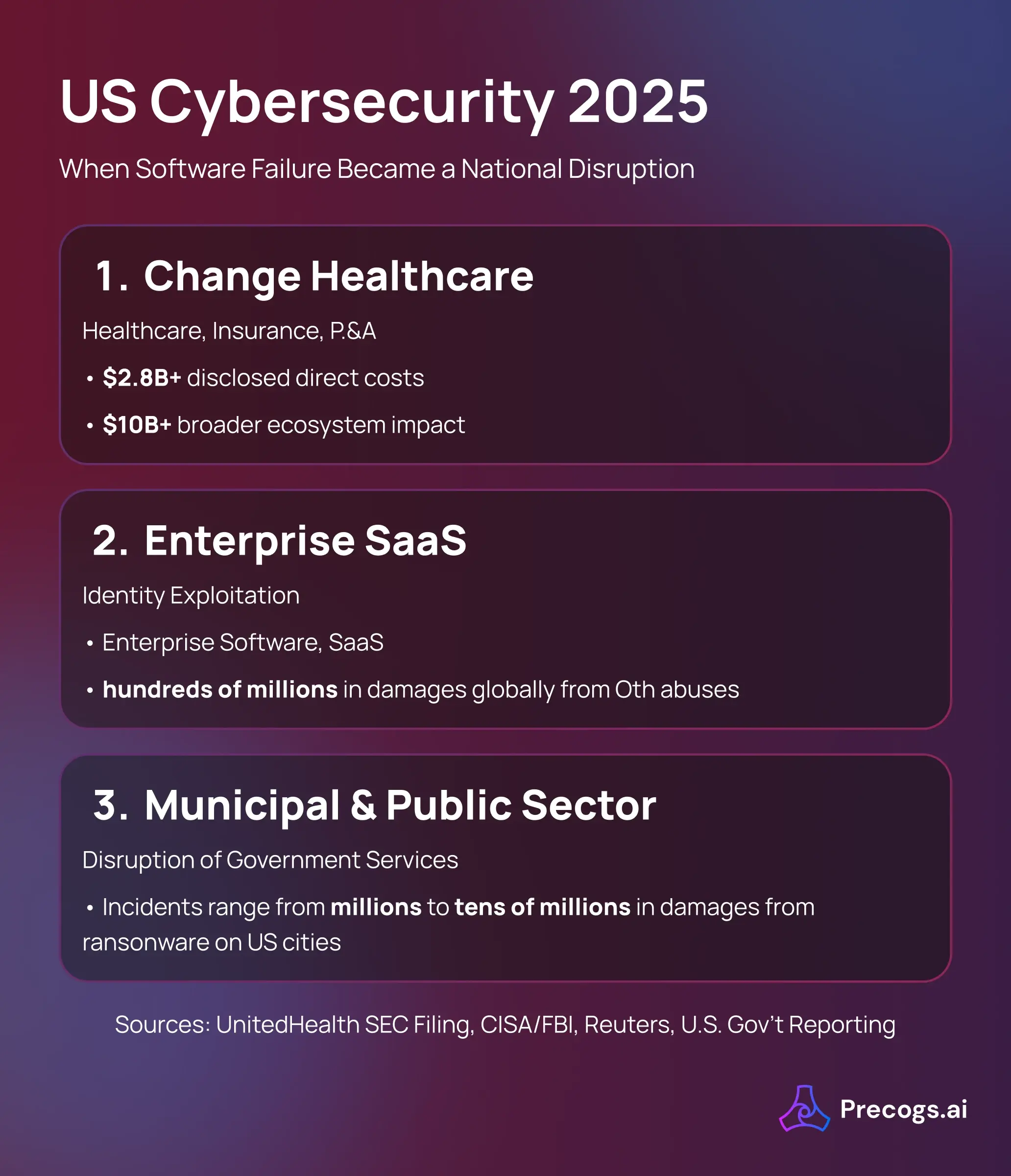
US Cyberattacks by the Numbers (2025)
Public disclosures, regulatory filings, and industry analysis indicate that the economic impact of cyber incidents in the US reached record levels in 2025.
Key indicators include:
- Billions of dollars in disclosed direct costs from individual incidents.
- An extended business interruption lasting weeks or months.
- Rising regulatory, legal, and class-action exposure.
- Growing concentration risk, where the failure of one provider disrupted thousands of downstream organizations.
In the US context, cyber incidents increasingly triggered financial disclosure obligations, investor scrutiny, and executive accountability.
Defining US Cyber Incidents of 2025
1. Change Healthcare: Healthcare as Critical Infrastructure
Sector: Healthcare, Insurance, Payments
What happened
The ransomware attack on Change Healthcare, a subsidiary of UnitedHealth Group, continued to reverberate through 2025. The incident disrupted prescription processing, insurance claims, and payment workflows across thousands of hospitals, pharmacies, and clinics nationwide.
Estimated cost
- UnitedHealth Group disclosed over $2.8 billion in direct costs related to response, remediation, and lost business.
- Industry analysts estimate broader ecosystem impact — including delayed care and operational disruption — exceeded $10 billion.
Why it matters
This incident demonstrated that healthcare intermediaries are national choke points. A single software failure cascaded into a patient care disruption on an unprecedented scale.
Healthcare cybersecurity is no longer a sectoral issue; it is a national one.
2. Enterprise Identity Exploitation: OAuth and SaaS Abuse
Sector: Enterprise Software, SaaS
What happened
Rather than breaching core platforms directly, attackers increasingly exploited OAuth tokens and third-party integrations to gain persistent, legitimate-looking access to enterprise SaaS environments.
Investigations confirmed that attackers often bypassed authentication entirely by abusing delegated trust relationships built into modern software ecosystems.
Estimated cost
- Losses were frequently underreported, but analysts estimate hundreds of millions of dollars globally in response costs, regulatory exposure, and customer churn attributable to identity-based SaaS abuse in 2025.
- Many organizations experienced months of undetected data access before discovery.
Why it matters
In the US enterprise environment, identity is now the perimeter. APIs and tokens represent some of the most valuable — and least protected — attack surfaces.
3. The Zero-Day Acceleration Problem
Sector: Enterprise Infrastructure
What happened
Multiple zero-day vulnerabilities in widely deployed enterprise software were exploited at scale in 2025 before organizations could test and deploy patches. The timeline from disclosure to exploitation collapsed dramatically.
Estimated cost
- Emergency patching, incident response, and downtime costs reached hundreds of millions of dollars across affected organizations.
- In many cases, exploitation began within hours of public or semi-public vulnerability awareness.
Why it matters
The traditional US enterprise security model — detect, patch, validate, deploy — no longer operates fast enough under zero-day conditions.
Being “aware” of a vulnerability no longer equates to being protected.
4. Municipal and Public Sector Disruption
Sector: State and Local Government
What happened
US municipalities continued to experience ransomware and operational cyber incidents that disrupted court systems, public records, utilities, and emergency services.
Estimated cost
- Individual city incidents ranged from millions to tens of millions of dollars in recovery, legal fees, and lost productivity.
- Long-term impacts included service backlogs, public trust erosion, and increased insurance premiums.
Why it matters
Local governments represent a persistent weak point: high public impact, limited budgets, and legacy infrastructure — often with no tolerance for downtime.
The Defining Pattern in the US: Speed and Logic Over Exploits
Across all major US incidents in 2025, attackers relied less on brute force and more on logic exploitation:
- Abusing trusted workflows rather than breaking authentication.
- Chaining small authorization gaps into systemic access.
- Exploiting identity and automation at machine speed.
AI-assisted tooling enabled attackers to:
- Probe APIs continuously.
- Map authorization paths automatically.
- Adapt instantly to defensive changes.
This was not traditional hacking. It was logic warfare executed at scale.
Why Traditional US Security Models Fell Behind
Despite heavy investment, many organizations shared the same weaknesses:
- Tools optimized for finding bugs, not understanding intent.
- Alert overload without an exploitability context.
- Remediation cycles are measured in weeks.
- Controls that failed open under pressure.
- Fragmented ownership across security, engineering, and compliance
In 2025, these gaps translated directly into financial, legal, and operational consequences.
The Shift to AI-Speed Defense
The lesson from US cyber incidents in 2025 is unambiguous:
If attackers can identify and exploit logic flaws instantly, defense must operate at the same speed.
This requires a shift:
- From scanning to reasoning.
- From alerts to reachable-path prioritization.
- From tickets to automated remediation.
Defense with Precogs AI
Precogs AI is designed for this new reality.
Instead of generating more findings, Precogs focuses on reducing exploitable paths by:
- Reasoning over code and dependencies to understand intent.
- Identifying logic and authorization flaws that attackers actually use.
- Prioritizing issues by reachability and real-world impact.
- Generating PR-ready remediation to close gaps quickly.
In an environment shaped by automation and speed, defense must think like the attacker — and move faster.
Looking Ahead: Priorities for 2026
2025 proved that cybersecurity in the United States is no longer an abstract technical concern. It is a national operational risk with financial, legal, and human consequences.
2026 will belong to organizations that:
- Treat identity and APIs as critical infrastructure.
- Reduce logic exposure early.
- Compress remediation cycles to machine speed.
The era of manual defence is over.
Explore the Cybersecurity 2025 Series
1. Global Cybersecurity 2025: The Year Code Broke the Physical World
2. UK Cybersecurity in 2025: How Operational Disruption Became the New Attack Strategy
3. EU Cybersecurity 2025: When Regulation Met Reality
4. MEA Cybersecurity 2025: Digital Transformation Under Fires
5. APAC Cybersecurity 2025: When Supply Chains Became the Front Line
Sources & References
- UnitedHealth Group disclosures on the Change Healthcare incident.
- SEC cyber incident reporting and materiality guidance
- Reuters investigative reporting on healthcare, SaaS, and enterprise software breaches
- US CISA and FBI cyber incident trend reporting