APAC Cybersecurity 2025: When Supply Chains Became the Front Line
Case Studies
In 2025, cyberattacks across the Asia-Pacific region exposed a critical global truth: APAC is no longer just a target — it is the attack surface.
Cyber incidents in APAC did not stay local. They halted manufacturing lines, disrupted logistics corridors, and sent shockwaves through global supply chains. From Japan and Southeast Asia to Australia and India, the most serious incidents shared a defining characteristic: software failures translated directly into physical and economic disruption.
The lesson from 2025 is clear:
When cyber risk hits APAC, the impact is felt worldwide.
This year-end review examines the most serious APAC cyber incidents of 2025, their estimated costs, the structural weaknesses they exposed, and why 2026 will demand AI-speed defence across industrial and supply-chain systems.
Key Takeaways for APAC CISOs and Security Leaders
- Manufacturing and logistics became primary targets: Attacks focused on stopping production, not stealing data.
- OT and IT convergence amplified risk: Automation systems and control planes were reachable through software.
- Supply-chain concentration magnified impact: A single disruption cascaded across global markets.
- Identity and automation were abused: Tokens, APIs, and service accounts became high-value attack paths.
- Downtime tolerance is minimal: In APAC manufacturing, minutes matter — days are catastrophic.
- Speed defines resilience: Organizations that closed exploitable paths early contained damage.
APAC Cyberattacks by the Numbers (2025)
While disclosure standards vary across APAC, public reporting and industry analysis indicate that 2025 was the most disruptive year on record for the region’s cyber-physical infrastructure.
Common indicators included:
- Hundreds of millions to billions of dollars in production and logistics losses per major incident
- Extended recovery timelines due to OT/ICS dependencies
- Cross-border economic ripple effects, impacting customers far beyond APAC
- Limited transparency complicates detection and coordinated response
In APAC, cyber risk is inseparable from manufacturing continuity and trade stability.
Defining APAC Cyber Incidents of 2025
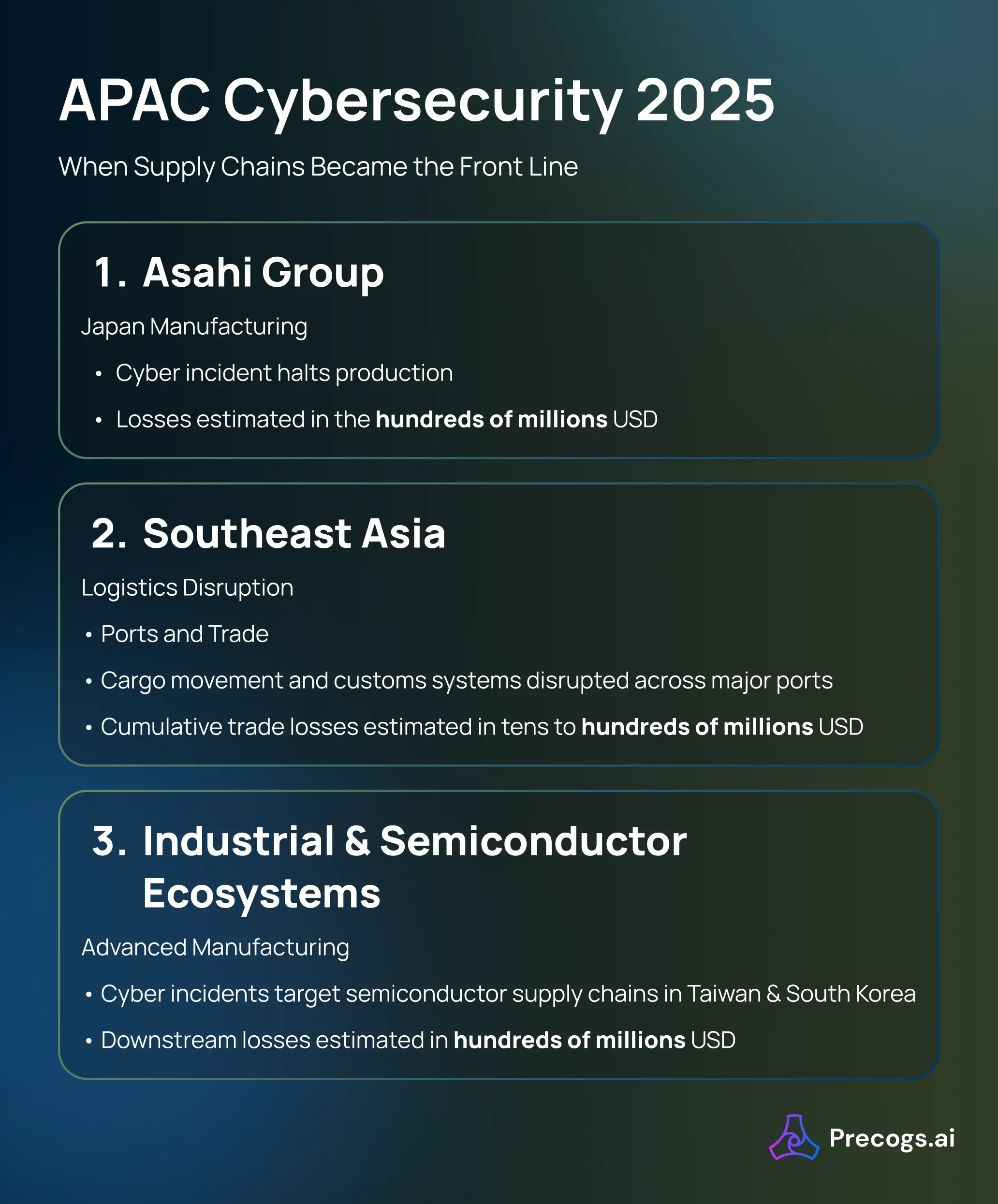
1. Asahi Group: Manufacturing Halt at Industrial Scale
Sector: Manufacturing, Consumer Goods (Japan)
What happened
In 2025, Asahi Group, one of Japan’s largest beverage manufacturers, confirmed a cyber incident that forced the shutdown of production and logistics systems across multiple facilities. Operations were halted as a precaution to prevent further spread.
Estimated cost
- Public reporting and analyst estimates place losses in the hundreds of millions of US dollars, accounting for halted production, recovery costs, and downstream supply disruption.
Why it matters
This incident demonstrated how industrial automation and business systems are now tightly coupled. When attackers reach the software controlling production workflows, they can stop physical output instantly.
2. Southeast Asia Logistics and Port Disruptions
Sector: Logistics, Shipping, Trade Infrastructure
What happened
Across Southeast Asia, cyber incidents disrupted port operations, customs systems, and logistics platforms. These incidents affected cargo movement, shipping schedules, and cross-border trade flows.
Estimated cost
- While individual losses were often undisclosed, trade analysts estimated tens to hundreds of millions of dollars in cumulative disruption due to delayed shipments, rerouting, and contractual penalties.
Why it matters
Ports and logistics hubs represent high-leverage choke points. Even short outages can cascade across regional and global supply chains.
3. Industrial and Semiconductor Ecosystems
Sector: Semiconductors, Advanced Manufacturing
What happened
Cyber incidents targeting suppliers and service providers within semiconductor and electronics manufacturing ecosystems raised concerns across Taiwan, South Korea, and Japan. While not all incidents resulted in public shutdowns, investigations confirmed attempts to reach automation pipelines and production support systems.
Estimated cost
- Industry estimates suggest that even brief disruptions in semiconductor supply chains can generate hundreds of millions of dollars in downstream losses, given global dependency.
Why it matters
APAC sits at the heart of the global semiconductor ecosystem. Cyber risk in this sector translates directly into geopolitical and economic risk.
4. Australia and Regional Public Sector Incidents
Sector: Government, Critical Services
What happened
Australia and neighbouring regions continued to experience cyber incidents affecting public services, healthcare systems, and education platforms. Several incidents required system shutdowns and prolonged recovery.
Estimated cost
- Individual incidents ranged from millions to tens of millions of dollars, factoring in response costs, service disruption, and long-term remediation.
Why it matters
Public sector systems often combine legacy infrastructure with modern digital services, creating complex attack surfaces with low downtime tolerance.
The Defining Pattern in APAC: OT Is the New Battleground
Across APAC incidents in 2025, a consistent pattern emerged:
- Attackers did not need malware sophistication — they needed access.
- Software paths into OT environments were reachable and trusted.
- Automation amplified the speed and scale of impact.
Attackers increasingly focused on:
- APIs connecting IT and OT systems.
- service accounts and automation credentials.
- workflow logic controlling production and logistics.
Once reached, these systems offered direct control over physical outcomes.
Why Traditional Security Models Failed in APAC
Despite strong perimeter and compliance controls, many organizations faced the same challenges:
- Security tools focused on IT, not OT logic.
- Limited visibility into automation workflows.
- Slow remediation cycles are incompatible with manufacturing uptime.
- Fragmented ownership between security, engineering, and operations.
In APAC environments, security delays equal production losses.
The 2026 Mandate: AI-Speed Defense for Supply Chains
The lesson from APAC in 2025 is unambiguous:
If software controls physical systems, cyber defence must operate at machine speed.
This requires a shift:
- From asset-centric security to path-centric defence.
- From periodic audits to continuous reasoning.
- From manual remediation to automated closure.
The Shift to AI-Speed Defense with Precogs AI
Precogs AI is designed for environments where logic, automation, and uptime converge.
Rather than producing more alerts, Precogs focuses on reducing exploitable paths by:
- Reasoning over code and dependencies to understand workflow intent.
- Identifying logic and authorisation flaws that expose automation pipelines.
- Prioritising issues by reachability and real-world impact.
- Generate PR-ready remediation to close gaps before production is affected.
In APAC, where minutes of downtime can ripple globally, speed is resilience.
Looking Ahead: Priorities for 2026
2025 showed that APAC is no longer just the world’s factory — it is the front line of cyber-physical risk.
2026 will belong to organizations that:
- Treat OT control planes as critical infrastructure.
- Secure identity and automation paths aggressively.
- Close logic gaps before attackers reach production systems.
Cybersecurity in APAC is now inseparable from global economic stability.
Explore the Cybersecurity 2025 Series
1. Global Cybersecurity 2025: The Year Code Broke the Physical World
2. US Cybersecurity 2025: When Software Failure Became a National Disruption
3. UK Cybersecurity in 2025: How Operational Disruption Became the New Attack Strategy
4. EU Cybersecurity 2025: When Regulation Met Reality
5. MEA Cybersecurity 2025: Digital Transformation Under Fires
Sources & References
- Reuters and Nikkei Asia reporting on Japanese manufacturing cyber incidents
- Public disclosures from Asahi Group
- Industry analysis on APAC logistics and port disruptions
- Government cybersecurity advisories from Japan, Australia, and ASEAN members
- World Economic Forum Global Cybersecurity Outlook (2025)